In an industrial cocoa processing line, removing the outer husk from the nib is an essential step after roasting. An industrial cocoa bean peeling cracks the roasted beans and separates the light shell from the dense cotyledon using vibration and air suction. Doing this properly protects downstream machinery from excessive wear and keeps bitter off-flavors out of the finished cocoa mass.
Why Cocoa Shells Must Be Removed Before Grinding
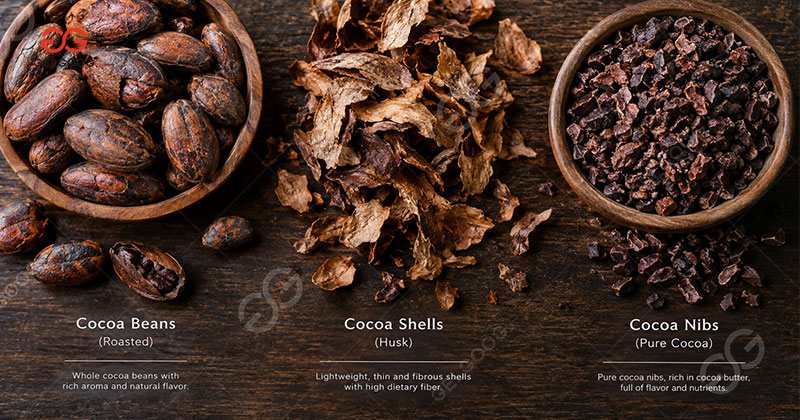
Raw cocoa beans contain 48% to 55% cocoa butter, 9% to 11% protein, 10% to 15% carbohydrates, and 7% to 8% minerals, ash, and theobromine. The outer shell accounts for 10% to 13% of the total bean mass.
Leaving the shell in the processing stream creates two serious problems:
First, the shell is rich in coarse fiber and polyphenols. It adds an acidic, astringent, and bitter taste that ruins product flavor.
Second, cocoa shell is extremely hard. If shells pass into a cocoa nibs grinding machine, they cause rapid abrasive wear on colloid mill teeth and ball mill steel balls. Shell particles also resist fine grinding, making it difficult to reach the standard target of 150 mesh . Before beans reach the cracker, a destoner like the GG-BQ200A (500 kg/h capacity) should first remove heavy stones and debris to prevent roller damage.
How Mechanical Cracking and Air Winnowing Work
Industrial cocoa bean peeling follows a mechanical sequence: conatrolled cracking followed by air aspiration.
Roasted beans have brittle husks. Inside the cracking chamber, adjustable rollers apply compressive shear to fracture the shell while keeping the nibs as intact as possible. Operators must avoid turning nibs into fine dust: small nib particles get swept away with the exhaust air, directly lowering fat recovery.
Once cracked, material drops onto vibrating screens driven by two counter-rotating vibration motors. The shaking action stratifies the bed, bringing lighter shell pieces to the top. Negative-pressure air channels then lift the shells away to a cyclone collector, while dense nibs pass through the screens. Any uncracked beans discharge into a return elevator or vacuum transfer tube to go through the rollers a second time.
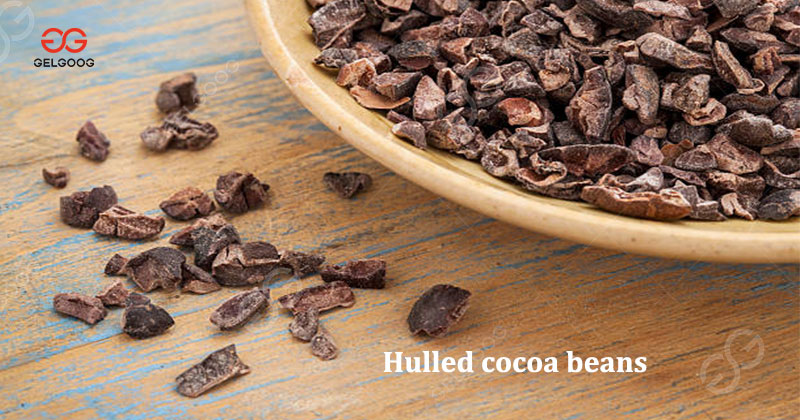
Equipment Comparison: Compact Peeling vs. Industrial Multi-Deck Winnower Unit
Processors select equipment configurations based on production volume, yield targets, and downstream specifications.
| Specification / Parameter | Compact Peeling (Single-Stage) | Industrial Winnower Unit (Multi-Deck) |
| Capacity | 300–500 kg/h | 500–1,000 kg/h |
| Screen Configuration | Single-layer screen (201 SS) | 5-layer classification sieves (304 SS, quick-release) |
| Cracking Rollers | 3 Polyurethane rollers (differential speed) | Chrome-plated carbon steel rollers (extended lifespan) |
| Power Consumption | 3.0 kW (1.1 kW drive, 0.75 kW fan) | 500 type: 10.75 kW / 1000 type: 11.75 kW |
| Airflow Capacity | 2,000 m³/h cyclone (1.5 kW fan) | 4,000 m³/h cyclone (7.5 kW fan) |
| Residual Shell in Nibs | ≥5% | ≤2% |
| Nib Loss in Shell | ≥10% | ≤2.5% |
| Nib Recovery Yield | 80%–83% | 88%–90% |
| Control System | Relay control, hanging box | PLC / centralized cabinet |
Field Operation: Tuning Roller Clearance and Airflow
Calibrating an industrial Cocoa Bean Peeling unit requires adjustments based on bean size and moisture:
1. Roller Gap Adjustment: Turn the adjustment handwheel counter-clockwise to reduce the roller gap if too many whole beans pass through uncracked. Turn the handwheel clockwise to widen the gap if you see excessive fine nib dust. The upper gap should typically match 1/2 to 2/3 of the average bean thickness, while the lower gap matches 1/2 to 2/3 of the minimum bean thickness.
2. Airflow Balancing: Check the clean nib discharge. If large shell pieces remain, increase suction on the second screen deck. If fine shell fragments remain, increase airflow on the third or fourth deck. If you see nib pieces inside the cyclone shell container, decrease suction immediately until losses stop.
3. Transport Pressure: When using pneumatic conveyors, check the negative pressure gauge on the vacuum feeder. If the pressure gauge stays above 0.02 MPa, clean the dust filter bags to clear internal blockages.
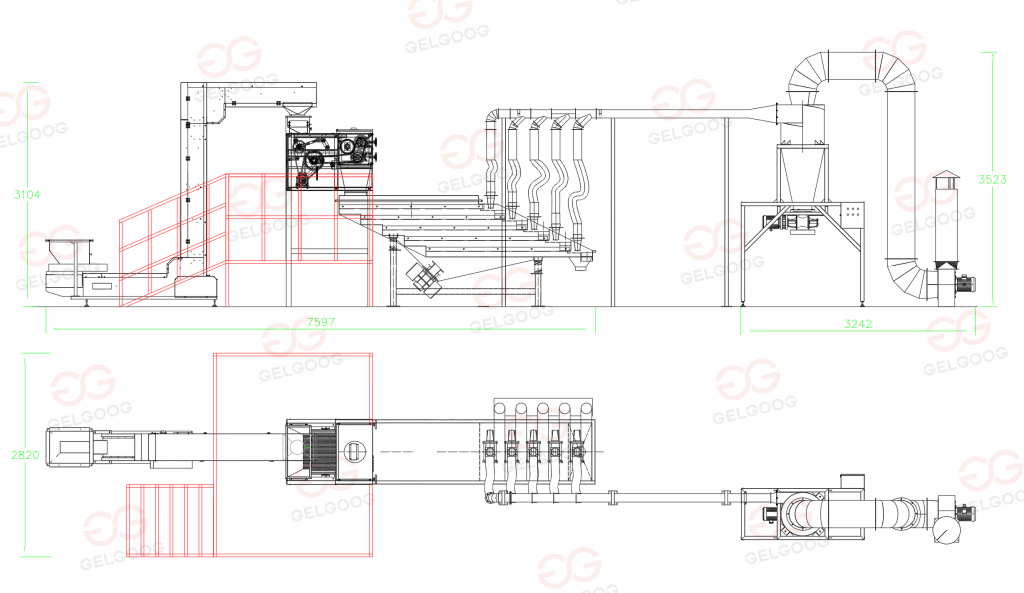
Selecting the Right Dehulling Configuration for Your Facility
Equipment choice directly affects annual profit through nib recovery yield:
A compact unit delivers 80% to 83% yield, with residual shell around 5% or higher. This works for regional craft processors, but the residual shell level is too high for commercial cocoa butter pressing.
An industrial multi-deck unit achieves 88% to 90% yield with residual shell at or below 2%. Over an annual production run, that 7% yield gain preserves substantial cocoa butter value and prevents filter mesh clogging in downstream cocoa processing equipment.
Frequently Asked Questions
Why does residual shell harm cocoa butter pressing?
Cocoa shell contains very little fat and does not compress like fatty nibs. High shell content causes uneven cake formation, damages hydraulic seals, and clogs filter press cloths during high-pressure cycles.
What causes nib loss in the shell exhaust?
Nib loss occurs when cracking rollers are set too close, crushing beans into fine dust. These light nib particles are carried into the cyclone along with the husk. Setting the correct roller gap and reducing suction on lower screen decks solves the problem.
Can raw cocoa beans be processed in this machine?
Raw bean shells are leathery and stick tightly to the seed. Beans must be roasted or thermally treated first so the husk becomes dry and brittle enough to crack cleanly under compressive shear.
How often should the classification screens be cleaned?
Blow down the screens with compressed air daily through the side plastic ports to clear blocked holes. Clean the screen surfaces weekly using a food-grade scraper to remove residual buildup.