Cocoa bean processing includes two different grinding stages that produce different products. The first stage grinds cocoa nibs into cocoa liquor, which is the foundation for chocolate and cocoa butter production. The second stage grinds pressed cocoa cake into cocoa powder after cocoa butter extraction. The path you need depends on the final product you want to sell, not on which machine looks bigger. This guide maps both paths, their fineness, and the machines that carry them.
The Grinding Stages After Cocoa Bean Processing
Cocoa bean grinding is a chain of two fineness levels, and each level has a clear job.
- After cocoa beans are roasted, cracked, and winnowed, the separated cocoa nibs enter the wet grinding stage. This gives 80-100 mesh cocoa liquor, with the stator and rotor set in 420 stainless steel and the food-contact parts in 304 or 316L.
- The ball mill does not grind cocoa beans directly; it further refines the cocoa liquor produced from nib grinding. The result reaches 20-25 microns, roughly 500 mesh, in a single pass with no regrinding needed.
- Dry grinding starts after cocoa butter pressing. The remaining cocoa cake becomes the raw material for cocoa powder production. A screen-set powder grinder delivers 20-120 mesh cocoa powder.
That chain answers most sizing questions before they start. If your product is chocolate or cocoa butter, you need the wet path and its two-stage cocoa liquor grinding. If your product is cocoa powder, you need cocoa powder grinding downstream on the dry path.
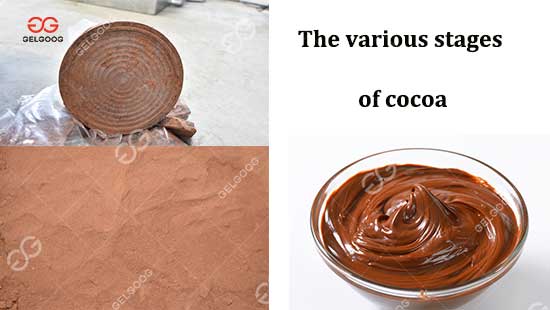
Wet Grinding: From Nibs to Cocoa Liquor
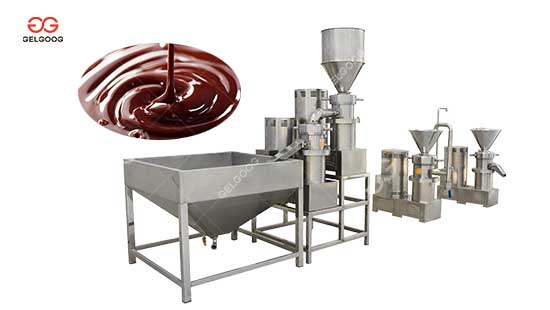
The wet grinding path starts after cocoa beans have been roasted, cracked, and separated into cocoa nibs. It converts cocoa nibs into cocoa liquor, which is used for chocolate manufacturing and cocoa butter extraction. Because cocoa bean grinding into liquor is the gate to both chocolate and cocoa butter. Within it, cocoa liquor grinding runs in two machines: a colloid mill first, then a ball mill.
The first machine is a colloid mill. It uses a stator and rotor with an adjustable gap, split into coarse, fine and ultrafine zones. Gelgoog’s colloid mills hold 80-100 mesh across six sizes, with capacities covering 100 kg/h up to 4000 kg/h. The rotor and stator use 420 stainless steel for wear resistance, while the food-contact surfaces use 304 or 316L. A single mill leaves the liquor around 70°C; a twin mill runs closer to 100°C.
One point matters here for anyone pressing cocoa butter later. Grinding the liquor too fine makes pressing harder, because the fine particles clog the filter cloth and slow the oil out. A mesh of around 100 is usually the practical target, fine enough for a clean liquor without adding friction to the press.
The second machine is a ball mill, and this is where fine grinding happens. Gelgoog’s ball mills reach 20-25 microns at 500 or 1000 kg/h, running continuously with a jacketed body and cooling system that keeps the liquor at or below 110°C. That temperature control is what protects the cocoa’s aroma during cocoa liquor grinding, and it is why fine grinding is always kept wet.
Dry Grinding: From Pressed Cake to Cocoa Powder
The “dry process” begins with the preassing stage. After the cocoa butter is extracted, the remaining product is a hard, cake-like mass—the raw material for producing cocoa powder.
The first step is breaking the cocoa cake. Gelgoog’s cocoa cake breaker offers processing capacities ranging from 100 kg to 600 kg per hour; it utilizes alloy steel blades and an adjustable screen to break the cocoa cake into small granules.
The second step is powder grinding. This equipment features a pendulum-style design with a rotational speed of 3,800 rpm, and the fineness—ranging from 20 to 120 mesh—can be adjusted by changing the screen. Gelgoog’s powder grinder has a processing capacity of 100 kg to 800 kg per hour. However, cocoa powder grinding typically requires coordination with upstream breaking and pressing equipment. Additionally, if an extremely fine and uniform powder is required, an ultrafine grinder equipped with air classification capabilities is often used during the grinding stage.
Which Path Fits Your Product
The decision comes down to the finished good, and one simple table clears it up.
| Raw material | Grinding stage | Final product | Key machine |
| Cocoa nibs | Wet grinding | Cocoa liquor | Colloid mill + Ball mill |
| Cocoa cake | Dry grinding | Serbuk koko | Cake breaker + Powder grinder |
The “wet method” and “dry method” are distinct stages within the same processing workflow. Most processors employ both techniques: the wet method is used first to extract cocoa butter, followed by the dry method to process the resulting cocoa cake into cocoa powder. Whether you plan to set up a single production line or utilize both processes, understanding these steps will enable you to plan your production line more effectively.
Soalan Lazim
What fineness does cocoa liquor need for chocolate?
Chocolate production calls for 20-25 microns. A ball mill reaches this in one pass after the colloid mill, so no separate regrinding step is needed.
Why is cocoa powder grinding always two stages?
The pressed cake is thick and firm. It has to be coarse-crushed first, then fine-ground through a screen to reach the target mesh.