The honest answer is that it depends on what you sell, and finer is not automatically better. Most commercial cocoa powder settles around 200 mesh, because that is where smoothness, cost and processing stability meet. Go much finer and you start paying for it in three places, which is the part most guides to cocoa powder particle size leave out.
Finer Cocoa Powder Grinding Costs More
The first cost is engineering. Moving from 200 mesh to 300 mesh is not the same mill running longer. It means a slower feed rate, a higher rotor speed, extra classification passes and more cooling, because every finer step asks the machine to break particles that are already small. A mill that comfortably holds 200 mesh at its rated output will often lose capacity the moment you push the target to 300 mesh. The grinding is still possible; the throughput is what changes. This is the first number to settle when you specify cocoa powder particle size, because the target you choose sets the mill and the power behind it.

The second cost is heat, this is important for cocoa. Cocoa butter softens around 35°C, and cocoa powder grinding turns mechanical energy into heat. Once the fat starts to soften, it smears, sticks to the screen and clogs it, and the whole run slows down. This is why fine grinding needs cooling built in, and why the press cake is coarsely crushed before it ever reaches the fine mill. Controlling cocoa powder particle size also requires balancing grinding intensity with temperature to prevent fat smearing and maintain stable production.
Match the Fineness to the Use
The cocoa powder grinding fineness is set by the application, not by the highest number on a data sheet. Coarse powder around 80 mesh works for bakery work where the cocoa is one ingredient among many. The general-purpose grade sits near 100 mesh. Beverage and instant-drink buyers want 200 mesh, because anything coarser settles out of the cup. Only the very finest grades, pushing past 325 mesh, justify their cost in premium drinking chocolate. Choosing the right target is the whole point: cocoa powder grinding fineness drives both product performance and production efficiency. The cocoa powder grinding machine page shows the units that hold each of these grades.
Cocoa Powder Particle Size Beats Mesh
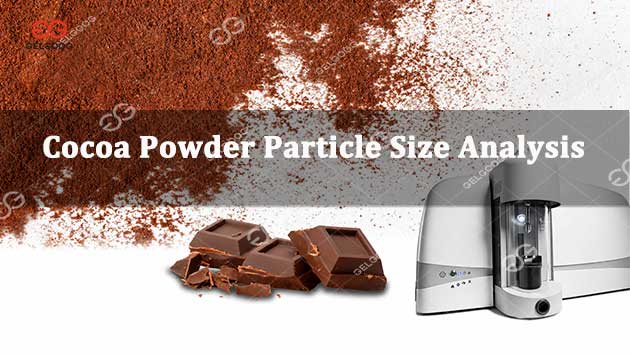
One clarification matters when you compare quotes. A spec that reads “99% passing 200 mesh” tells you the sieve opening, not the actual size of every particle. The particles are irregular and clump together, so two powders can both pass 200 mesh and still behave differently in a mixer or a drink. This is why cocoa powder particle size is stated as D50 and D90, measured by laser diffraction. D90 is the number that predicts grittiness: it marks the largest particles, and it is those, not the average, that a tongue notices.
Verifying fineness has its own trap. Dry sieving cocoa powder works poorly because the fat and static make the particles stick, so wet sieving is the reliable method. This is also why cocoa powder particle size is best read from a laser-diffraction result rather than a sieve alone, and why a quoted cocoa powder grinding fineness should always name the test behind it. Our dry-path grinders, from the GG-S20B through the GG-S60B, cover 20 to 120 mesh and change fineness by swapping the screen. The wet path, with the GG-JMS colloid mill feeding a GG-CQM ball mill, reaches 20 to 25 microns for liquor, as the ball mill for cocoa liquor page sets out.
FAQ
What mesh is standard for cocoa powder?
Around 200 mesh, or roughly 99% passing 75 microns, is the commercial reference for fine cocoa powder.
Why not grind everything as fine as possible?
Finer grinding raises energy, heat and dust while cutting throughput, and beyond a point it adds nothing to the finished product.
How is fineness actually checked?
Wet sieving is more reliable than dry sieving, and laser diffraction gives D50 and D90, with D90 flagging the coarse particles that cause grittiness.