Winnowing is the step that turns roasted cocoa beans into two clean streams — the nibs that become chocolate and the shells that are thrown away. Done well, it keeps the nibs pure and the waste empty. The process of winnowing cocoa beans is deceptively simple: crack, screen, and separate with air. What makes it work is how carefully those three steps are matched, and this guide walks through the whole sequence.
Where the Process of Winnowing Cocoa Beans Begins
The process of winnowing cocoa beans starts before any air moves. Roasted and cooled beans enter a cracker, which crushes each bean just enough to split the shell away from the nib inside. The goal is not to grind — it is to open the shell while keeping the nib in large, intact pieces.

The crack size decides everything downstream. Crack too coarsely and the shell stays fused to the nib, so the separation step has to work against stuck material. Crack too finely and you create nib fines, tiny nib particles that are hard to tell from shell fragments and that drift into the waste as loss. The most reliable lines crack to a size that opens the shell without pulverizing the nib, then move the mixture on for screening.
Cracking and Winnowing Cocoa Beans: Screening and Air
After cracking, the mixture of nibs and shells goes through two working stages: first screening, then air separation.
- Screening sorts the cracked mixture into size fractions, because nibs and shells of the same size are easier to separate than a mixed jumble. A multi-deck screen splits the load into bands, and each band is then treated with its own air setting.
- Air separation lifts the light shells away from the heavier nibs. Because nibs are denser than shells, a controlled airflow carries the shells up and out while the nibs fall through to the product stream.
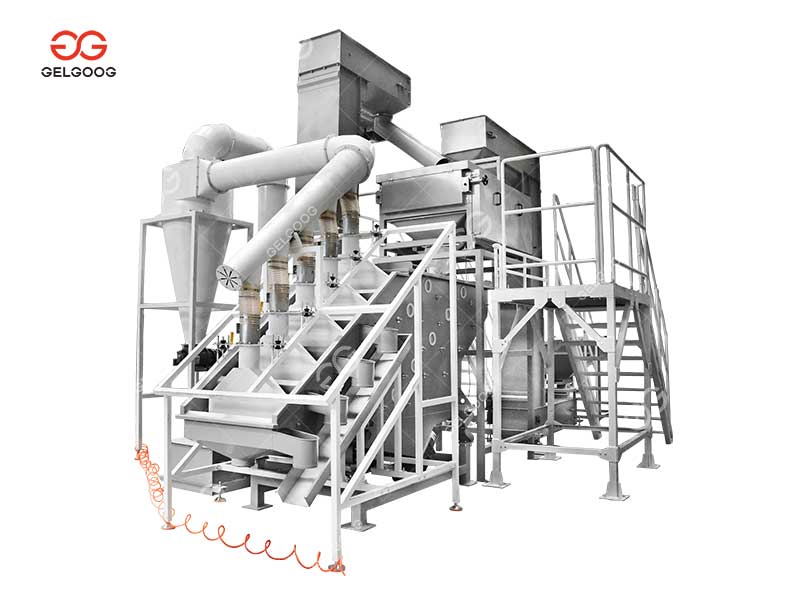
This is where cracking and winnowing cocoa beans become one continuous operation. A machine that lets you tune the airflow for each size fraction will hold a clean separation across different bean varieties, where a single fixed blast struggles the moment the material changes. For a processor choosing equipment, understanding cracking and winnowing cocoa beans as a matched pair — rather than two separate machines — is what keeps the nib stream clean. That is exactly why the cracker and winnower for cocoa beans is built as one unit rather than a cracker feeding a separate winnower.
The Two Numbers That Measure a Clean Winnow
Two ratios tell you whether winnowing is running clean, and they point in opposite directions:
- Shell in nibs is the quality number — how much shell ends up in the product. Leftover shell dulls the cocoa liquor and adds unwanted fibre.
- Nibs in shell is the yield number — how much good nib is lost to the waste stream. Every percentage point here is cocoa you paid for and threw away.
Gelgoog’s winnowing systems hold both tight: the listed processing capacity runs at 500 and 1000 kg/h, with shell in nibs below 2% and nibs in shell below 2%, and nib size at 96% above 1.0 mm. A 500 kg/h unit draws 7.5 kW in a 7500 × 2800 × 3500 mm frame, while the 1000 kg/h unit draws 9.5 kW in 8500 × 3400 × 4000 mm, and smaller lines can start from a 300 kg/h unit. When comparing suppliers, ask for both ratios and the conditions they were measured under — bean origin, moisture and batch size — because a number without those conditions is just a claim. Getting the process of winnowing cocoa beans right comes down to holding both of those numbers, not chasing a bigger headline capacity.

Where Winnowing Sits in the Flow
Winnowing never runs alone. It sits between the roaster upstream and the grinder downstream, and the capacity you pick only matters when all three agree.
- Upstream, the roaster sets how much material arrives — a winnower sized far above the roaster’s steady output runs half-empty.
- Downstream, the grinder sets the nib demand, so the winnower should match what the next stage can actually consume.
- Around the machine, check whether un-cracked beans are automatically returned for re-cracking, and where the shell and dust are collected — both shape the real throughput of a full shift.
The process of winnowing cocoa beans looks small on a flow chart, but it is the point where a processor either keeps the cocoa they paid for or quietly loses it. Crack to open the shell, screen into size bands, separate with tuned air, and watch the two separation numbers — and the winnower will deliver clean nibs shift after shift.